Computer Vision • Edge Intelligence
Greater AI
An attentive doorway, not another camera. Greater AI turns a recognized arrival into a timely greeting and a useful household signal.
Perception
A doorway that notices context, not just motion.
Greater AI detects a face, converts it into a FaceNet embedding, and asks a trained SVM classifier whether the visitor is familiar. Recognition is confidence-gated, so a weak prediction remains an unknown visitor instead of becoming a confident mistake.
The camera and classification loop run on the host. GPU acceleration is used when available, while an OpenVINO path keeps edge hardware part of the design rather than an afterthought.
Detection first
MTCNN isolates a credible face before the recognition pipeline does any identity work.
Confidence gated
FaceNet embeddings and an SVM label are accepted only after crossing explicit thresholds.
Quiet by design
A repeat-arrival window prevents the same visitor from triggering a stream of duplicate events.
Reaction
One recognition event. Two useful responses.
A successful match updates a recognition subject. Independent observers then react concurrently: one prepares a spoken welcome at the doorway, while another sends a concise arrival notification to the household.
That separation matters. Recognition does not need to understand speakers, messaging APIs, or future automations; new reactions can subscribe without tangling the perception loop.
Spoken welcome
The visitor receives immediate acknowledgement without waiting for someone to answer the door.
Household signal
A short arrival message reaches the configured household channel after recognition.
Observer fan-out
Concurrent observers keep integrations replaceable and the recognition path focused.
The Boundary
Useful recognition needs deliberate restraint.
The browser demo below is intentionally synthetic: it requests no camera permission, performs no biometric analysis, and stores no visitor data. It demonstrates the event choreography without turning a portfolio visit into a surveillance exercise.
In the system design, identity decisions remain confidence-gated and repeat events are suppressed. External speech and messaging integrations receive only what their response requires after a match.
No browser camera
The interactive demo uses a generated scene and never requests access to your device camera.
Unknown stays unknown
Low-confidence visitors follow a neutral path instead of inheriting the nearest identity.
Minimal event payload
Downstream reactions are designed around the arrival signal rather than an unnecessary data bundle.
Interactive Demo
Watch an arrival become a welcome
Choose a familiar or unknown visitor and follow the privacy-safe simulation from detection through the final household signal.
Greater AI / Entrance 01
Awaiting simulated arrival
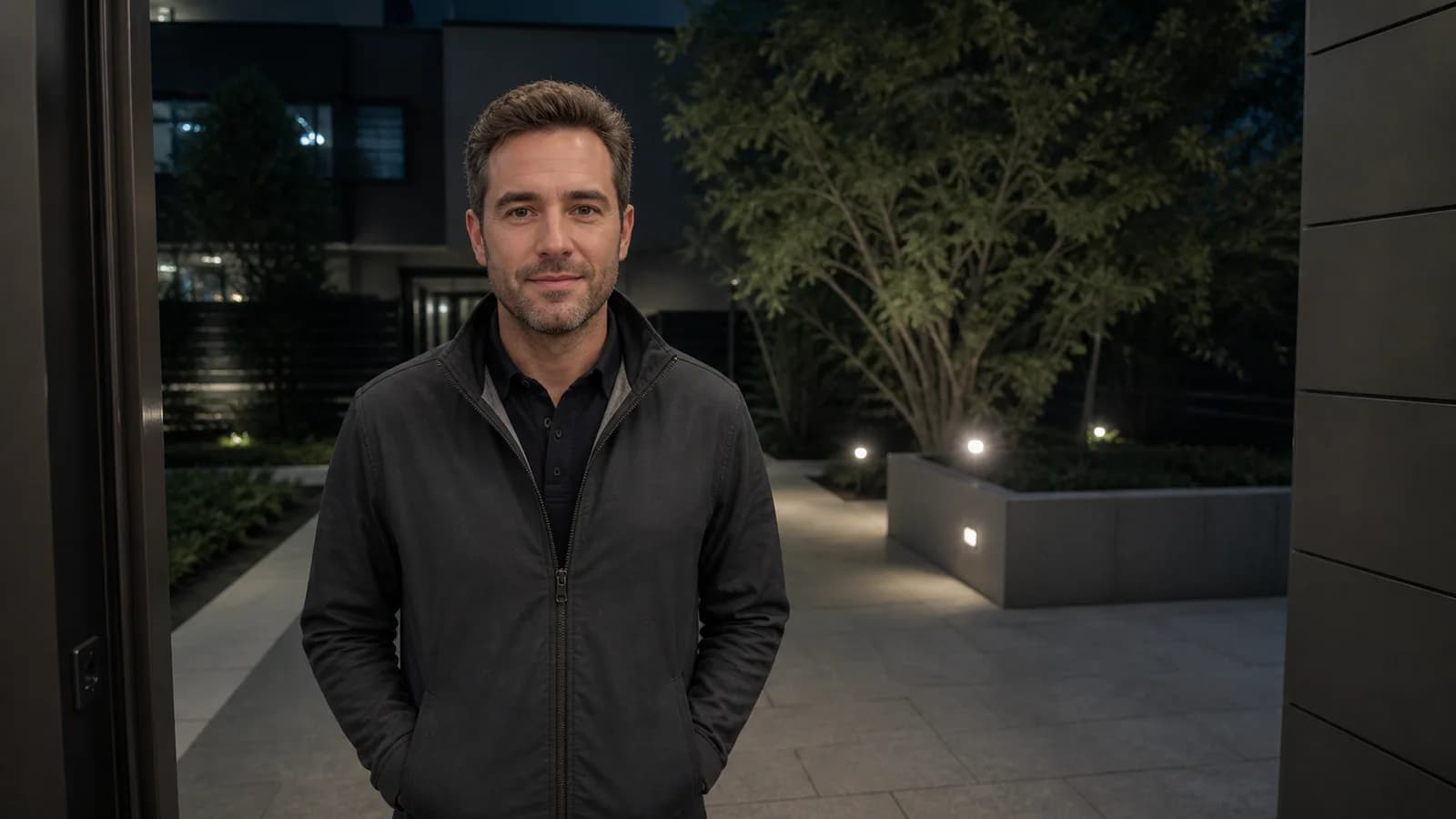
21:42:08 / CAM 01
Event pipeline
From pixels to presence
Face detected
MTCNN detection • 98.7%
Embedding created
FaceNet • 512 dimensions
Visitor recognized
Avery • 94.8% match
Welcome prepared
Response observer acknowledged
Household notified
Avery has arrived
Recognition & Response Stack
 Python
 PyTorch
 FaceNet
 MTCNN
MTCNN OpenCV
 SVM
SVM OpenVINO
 Telegram API
 gTTS
gTTS Observer Pattern
The Doorway Responds
Recognition is only valuable when the response feels human.
Greater AI explores the small but meaningful interval between someone arriving and a household becoming aware: detect carefully, decide conservatively, then respond without friction.
Greater AI • Built by Abhishek Kashyap
Explore the public source
The public Python code shows the recognition subject, observer fan-out, notification strategy, speech strategy, and FaceNet-based classification loop behind the original prototype.
View Repository (opens in a new tab)A replaceable reaction layer
Recognition publishes an event; speakers and notifiers subscribe independently. That boundary leaves room for new delivery channels without rewriting the computer-vision core.